
Thursday, December 31, 2015
Five Minute Enrichment Sessions = My Goal for the New Year!
It's New Year's resolution time! My thoughts are that as a math interventionist I don't get a lot of time to work with students who are more advanced in mathematics. Teachers I work with tell me they also feel this way as they are constantly pouring their every minute into supporting students at the bottom. Therefore, my New Year's resolution is to spend 5 minutes a day with a student who needs enrichment and to give ideas to teachers on how to also dedicate this 'feel-good' time.
Here is my dastardly plan to fit in a bit of math every day with an advanced learner (or two or three):
1. Meet a student or two at his or her locker at the beginning or end of the day.
Believe it or not, the more advanced students are always in learning mode and can absolutely focus at their locker after a long day and when the halls are busy.
2. Whisper to a kid during my push-in time when the classroom teacher is doing direct instruction and my at-risk kids are listening.
Obviously the classroom teacher can't take advantage of this move- well maybe depending on their teaching style!
3. Sit an advanced kid on the other side of me and the struggler(s) I am working with in the regular classroom. Tag-team the two levels. While my struggler(s) is/are working, I can whisper to an advanced kid, or better yet silently write to the advanced student(s).
4. Each one, teach one. Have you heard of this? In short, have the advanced student tell another advanced student the challenge problem and see if that student can solve it. Without classroom disruptions, of course! Even suggest he/she share the challenge in the lunch room. Believe me, only the math geeks will be interested in spending their lunch time on a math problem! And the leading student will be excited to take pencils and scrap paper to the lunchroom!
What can I do to enrich in just a few minutes?
Saturday, November 28, 2015
Start Unknown, Change Unknown, Result Unknown
As you know, you can't teach everything at once. So, all this business of start unknown, change unknown and result unknown on top of add to, take from, put together/take apart and compare...is quite daunting. Do the words ever end? No they don't because that is just part of the problem solving vocabulary in that lovely table in the Common Core document- you know the one.
This year I have been hearing more and more that my little second graders (from the classroom in which I team teach) need to be able to identify these situations and match stories to equations of all types. UGH!!! So, where do I begin to conquer the beast? Read the story, understand it, identify the position of the unknown and write an equation. Addition and subtraction are inverses so if one student solves it with addition (counting up) and another with subtraction...how do we now match to the correct equation among the foils!
Since I don't have the option to not teach this, I have decided to begin with straight computation lessons on solving equations with unknowns in all positions. The best part about this is that my students have found it fun to solve these complex equations. And, bonus! I believe they have become stronger mathematicians. Thus, to keep my kiddos fresh on the skills they have learned, I created some practice pages for addition and subtraction with unknowns in all places as well as vertically aligned practice and equations that start with the result. If you try them, be sure you have taught how to solve all of these situations and most importantly that subtraction starts with the whole group or sometimes I say subtraction starts with all you have, and be sure students understand what they call 'backwards' equations such as 9 = 15 - 6. That's lots of teaching but once you do it, you will have practice for them for some time to come. Click on the picture below to head over to my store and check these out.

This year I have been hearing more and more that my little second graders (from the classroom in which I team teach) need to be able to identify these situations and match stories to equations of all types. UGH!!! So, where do I begin to conquer the beast? Read the story, understand it, identify the position of the unknown and write an equation. Addition and subtraction are inverses so if one student solves it with addition (counting up) and another with subtraction...how do we now match to the correct equation among the foils!
Since I don't have the option to not teach this, I have decided to begin with straight computation lessons on solving equations with unknowns in all positions. The best part about this is that my students have found it fun to solve these complex equations. And, bonus! I believe they have become stronger mathematicians. Thus, to keep my kiddos fresh on the skills they have learned, I created some practice pages for addition and subtraction with unknowns in all places as well as vertically aligned practice and equations that start with the result. If you try them, be sure you have taught how to solve all of these situations and most importantly that subtraction starts with the whole group or sometimes I say subtraction starts with all you have, and be sure students understand what they call 'backwards' equations such as 9 = 15 - 6. That's lots of teaching but once you do it, you will have practice for them for some time to come. Click on the picture below to head over to my store and check these out.
Sunday, October 11, 2015
Number Words Chart
My students and I are working hard to make gains in the quality of writing in their math journals (or notebooks). I am looking for better/deeper explanation of mathematical thinking as they write about their problem solving strategies. Not just "I found it by adding 3 + 5", but rather, "Because it says she "found more," I know her pile of marbles got bigger so I added. This focus on improved explaining with words, has resulted in some students wanting to write "three plus five" thinking that is better than 3 + 5. Well, at least they are working on changing something! As a result my students ask me how to spell every number word. When I tell them to "sound it out" I find that number words are not the easiest to sound out! Hence I created a Free Number Word Reference Chart to put in my math tubs to give students a tool to spell with, and to free me up for more conferencing on verbalizing their math ideas and then writing them down to explain. I hope you can use it!


Wednesday, October 7, 2015
Counting Intervention for Students in 2nd and 3rd Grades
After a full month of school, I have been challenged by a handful of students in grades second and third who do not have the counting sequence secure. Most students can count up to 10 and back, but going through the teens is troublesome. A few have up to 20 and back but I have noticed the most commonly skipped teen in their sequence is 13. "Pooooooor 13!" we cry as they count and I write what they say. And some falter when counting up to 30 and back, often skipping 20. "23, 22, 21, 19,,,"
For struggling students, this is a lengthy pattern to remember, this I know. And when counting our pattern doesn't normally start with zero. So it does make a bit of sense that students successfully count from 1 to 19 and forget what I call, "twenty-zero," and go straight to 21. Though not as big of a mistake counting up, skipping the decade happens more frequently counting back. "34, 33, 32, 31, 29, 28, 27..." Other than practice, practice, practice, I have taught some students to say "thirty-zero" and then we giggle and laugh and I ask them, "What number is thirty-zero really?" And when we continue to count back we are sure to count back all the way to zero. Zero has to be included in our pattern!
If you need counting up and back practice, I have created some short pages with many uses. I hope you find them useful!
For The Great Count ON, click below:
https://www.teacherspayteachers.com/Product/Counting-on-Practice-from-Any-Number-2135978
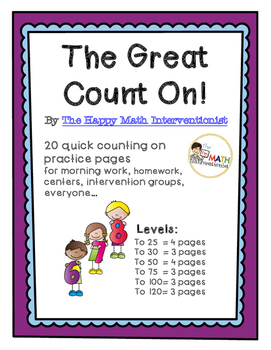
For The Great Count BACK, click below:
https://www.teacherspayteachers.com/Product/Counting-Back-Practice-Pages-2135752
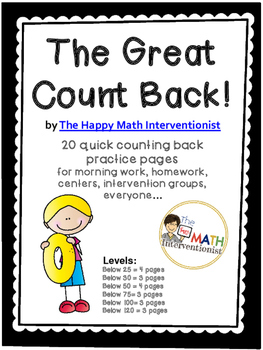
Have a GREAT week!
For struggling students, this is a lengthy pattern to remember, this I know. And when counting our pattern doesn't normally start with zero. So it does make a bit of sense that students successfully count from 1 to 19 and forget what I call, "twenty-zero," and go straight to 21. Though not as big of a mistake counting up, skipping the decade happens more frequently counting back. "34, 33, 32, 31, 29, 28, 27..." Other than practice, practice, practice, I have taught some students to say "thirty-zero" and then we giggle and laugh and I ask them, "What number is thirty-zero really?" And when we continue to count back we are sure to count back all the way to zero. Zero has to be included in our pattern!
If you need counting up and back practice, I have created some short pages with many uses. I hope you find them useful!
For The Great Count ON, click below:
https://www.teacherspayteachers.com/Product/Counting-on-Practice-from-Any-Number-2135978
For The Great Count BACK, click below:
https://www.teacherspayteachers.com/Product/Counting-Back-Practice-Pages-2135752
Have a GREAT week!
Monday, September 21, 2015
Start, Change, Result vs. Part, Part, Whole
I literally spent the entire weekend contemplating the role of the part, part, whole diagram so prevalent in enVision math. This versus the role of the vocabulary 'start, change, result'. It is hard enough to get second graders to solve story problems using a part, part, whole, I wondered how to add to that with start, change, result. I was convinced struggling students would never handle both. And then there is, "Is this a joining problem or is this separating?" The words seem to never end. And then I consulted the 'Bible' (the CCSS) and realized that part, part, whole is not specifically stated anywhere in the standards (please correct me if I am wrong). I came to the conclusion that it is not start, change, result that is the problem. I actually love how start, change, result so clearly assists in equation writing with a symbol for the unknown. Truly, for strugglers I believe it is part, part, whole that is confusing! But part, part, whole does have an excellent use as an organizer for decomposing numbers. My question is do you prefer to use the vocabulary 'start, change, result' with struggling students while teaching problem solving, or do you think they better understand the part, part, whole when writing an equation to match a story?
Subscribe to:
Posts (Atom)